

XRP has moved into a new phase of selling pressure following small spot ETF inflows, stunted legislative advancement and weakening technical pointers placing large burdens on market confidence. The altcoin has dipped by 12% in November alone. The recent death cross and decreasing institutional focus have raised concerns. XRP is likely to revisit the monthly low of $1.8239 unless the momentum changes positively.
ETF Inflows are below Expectations
The inflows in XRP-spot ETFs were small during the week of 28 November, which weakened the expectations that institutional demand would build up after the funds were launched. The total inflows are now up to $666.61 million, and $22.68 million was added on 28 November. Market analysts forecasted much greater accumulation, particularly with Bitcoin ETF market recording all-time capital inflows this year.
Canary XRP ETF (XRPC) continues to dominate the market with inflows of $343.67 million. Meanwhile, Franklin XRP ETF (XRPZ) and Bitwise XRP ETF (XRP) have gained $85.22 million and $166.04 million respectively since inception on 24 November. These numbers are still not strong enough to propel XRP out of its ongoing downward trend, although they keep improving. The fact that no BlackRock iShares XRP Trust exists is still a major issue among investors who want higher institutional participation.
Market Structure Bill Forms Downside Pressure.
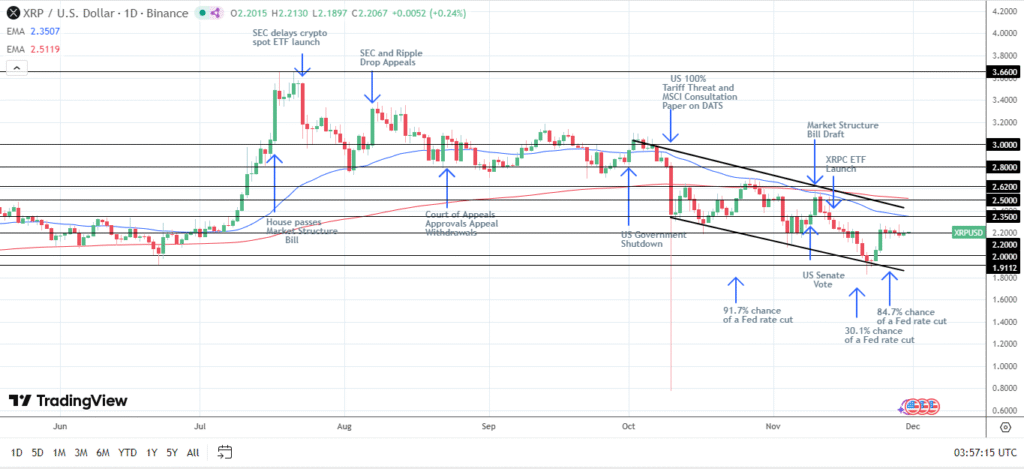
The XRP has been weaker due to regulatory trends as well. The Market Structure Bill, passing the House 17 July, and causing a 14.69% rally then, has been stalled in Senate by political squabbles and the recent U.S. government shutdown. The slowdown has constrained the prospects of regaining clarity in the near future, curbing the prospects of a wider market recovery.
Also, the current MSCI consultation on the potential delisting of digital asset treasury companies has diminished interest in XRP as a corporate reserve asset.
Technical Indicators Support a Bearish Near-Time Prognosis.
On 29 November, XRP closed at $2.2015, gaining 0.91% daily but still lower than the 50-day and 200-day Exponential Moving Averages. At $2.3507 and in the case of $2.5119, these EMAs still remain solid resistance levels.
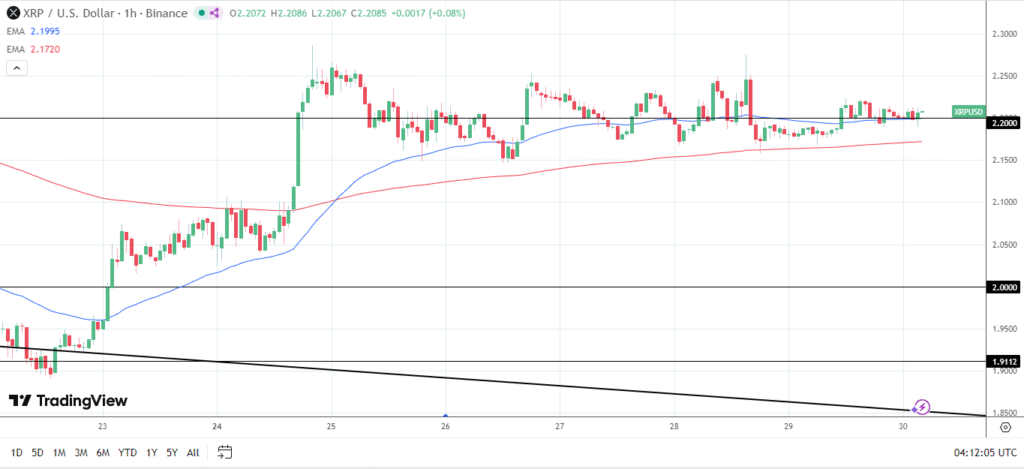
XRPUSD – Hourly Chart
The recent death cross, which was created in mid-November, is a bearish signal that is closely observed. As the token trades under the key averages, the selling pressure has increased. The key support levels are at $2.20, $2.00, $1.9112 and November low of $1.8239 which has become a significant line of defence to bulls.
Analysts caution that with ETF inflows kept subdued and stagnation in legislative gains, a decline to $1.82 is by no means improbable over the coming few weeks.
Medium-Term Prospective has Potential but is Weak in the short-term.
Although the short-term situation is still difficult, a number of medium-term triggers may rejuvenate the XRP performance:
- The launch of BlackRock iShares XRP Trust.
- A possible reduction in Fed rates in December.
- Chartered banking licence of Ripple in the United States.
- Market Structure Bill passed by the Senate.
- More blue-chip companies begin to use XRP as their treasury.
The combination of these factors might cause XRP to start climbing towards July all-time high of $3.66, and a breakout would open the potential way to $5.
Conclusion: XRP Moves toward a Critical Pivot.
XRP enters the last days of November with increased downside risks. Recovery efforts are still curtailed by weak inflows in ETFs, political barriers, and technical resistance. The traders are also watching the psychological mark of $2.00 that is likely to determine whether the token stabilises or proceeds on a more serious correction.
Nevertheless, any change in U.S. regulation, ETF behavior, or macroeconomic factors might easily change the mood of the market. At this point, XRP is solidly standing at one of its most important decision points of the quarter.

1 Comment
Pingback: XRP Price Holds $2.19 as Futures Interest Crashes 59% - cryptogiant