

Bitcoin has created more millionaires than any asset in the past decade, but its volatility also scares away countless beginners who want to invest in bitcoin.
If you’re interested in how to invest in Bitcoin for beginners but worried about losing money, you’re asking the right questions. The good news? Low-risk Bitcoin investment strategies exist – and they’re simpler than you think.
Here’s what most beginners don’t understand: Low risk doesn’t mean zero risk – Bitcoin is inherently volatile. Instead, it means reducing your exposure through small, consistent investments, using proven strategies like dollar-cost averaging, avoiding emotional decisions driven by FOMO or panic, prioritizing security and safe platforms, and starting with amounts you can genuinely afford to lose. This approach has helped thousands of beginners I’ve taught over the past decade enter Bitcoin safely.
Is Bitcoin a good investment for beginners? Yes, if approached correctly. Bitcoin is a proven digital asset with a 15-year track record, but its volatility requires disciplined strategy. Beginners who use dollar-cost averaging, start small, and prioritize security can invest in Bitcoin while managing risk effectively.
This guide covers seven low-risk ways to start investing in Bitcoin, from choosing safe platforms to storing your investment securely. You’ll learn specific strategies, avoid common beginner mistakes, and get a clear roadmap for your first Bitcoin purchase.
Table of Contents
- Understanding Bitcoin Risk: Why Volatility Matters
- 7 Low-Risk Ways to Start Investing in Bitcoin
- Risk Management Principles Every Bitcoin Investor Needs
- Red Flags to Avoid When Investing in Bitcoin
- Your Step-by-Step Bitcoin Investment Roadmap
- Frequently Asked Questions About Investing in Bitcoin
- Start Your Bitcoin Investment Journey Today
- About This Guide
- References
Understanding Bitcoin Risk: Why Volatility Matters
Before investing, you need to understand what you’re getting into. Bitcoin’s potential for gains comes with significant volatility. Here’s what drives that volatility and why beginners often lose money – so you can avoid their mistakes.
Why Bitcoin Is Volatile
Bitcoin volatility stems from several interconnected factors that create dramatic price swings:
Limited supply meets variable demand. Only 21 million Bitcoin will ever exist. When demand surges during bull markets, prices skyrocket. When fear dominates bear markets, prices crash. This supply constraint amplifies every price movement because there’s no way to create more Bitcoin when demand increases.
24/7 global market operation. Unlike stock markets that close at specific hours, Bitcoin trades continuously across global exchanges. News from China at 3 AM Eastern time can move prices instantly, and there’s no closing bell to pause trading during panic or euphoria.
Relatively small market capitalization. At approximately $800 billion, Bitcoin’s market cap is smaller than Apple’s. Large trades can move the market significantly – a single institutional investor buying or selling billions can trigger cascading price movements.
Speculation drives short-term moves. Many participants trade Bitcoin based on price predictions rather than long-term value assessment. This creates rapid swings as traders react to technical indicators, news, or social media sentiment.
Regulatory uncertainty. Government announcements about Bitcoin regulation can trigger major price movements within minutes. When China banned mining in 2021, Bitcoin dropped 50%. When El Salvador adopted it as legal tender, prices surged.
Understanding this volatility is crucial: Bitcoin can drop 20-30% in days, then recover just as quickly. This isn’t a sign that Bitcoin is “broken” – it’s the reality of an emerging asset class finding its equilibrium price globally.
Why Beginners Lose Money (And How to Avoid It)
The patterns are consistent across thousands of beginner investors I’ve worked with. Here are the most common mistakes and their solutions:
FOMO buying at peaks. Beginners see Bitcoin surge 50% and buy at the peak, afraid of missing out. The price inevitably corrects 30%, and they panic-sell at a loss. Solution: Dollar-cost averaging (covered below) removes this emotional roller coaster by spreading purchases across all market conditions.
Panic selling during crashes. Bitcoin drops 20% in a week, and fear takes over. Beginners sell to “stop the bleeding,” locking in losses. Then Bitcoin recovers to new highs while they’re on the sidelines. Solution: Predetermined investment timeline of 3-5+ years means short-term drops become irrelevant.
No clear strategy. Random buying whenever it “feels right” leads to consistently poor timing. Without a plan, emotions dictate every decision. Solution: Written investment plan with specific rules about when, how much, and under what conditions you’ll buy.
Using leverage or borrowed money. Some beginners try to amplify gains by borrowing money or using margin trading. A 10% drop can wipe out their entire position through liquidation. Solution: Only invest money you already own and can afford to lose completely.
Poor security practices. Leaving Bitcoin on sketchy exchanges, clicking phishing links, or sharing seed phrases leads to total loss through theft. Solution: Use regulated platforms, enable 2FA, and move significant amounts to hardware wallets.
Trying to time the market. Waiting for the “perfect” entry price means missing years of gains while Bitcoin appreciates. By the time you’re confident it’s the bottom, the price has already recovered. Solution: Accept that perfect timing is impossible and focus on consistent accumulation.
Investing more than they can afford to lose. Using rent money, emergency funds, or taking loans to invest in Bitcoin creates devastating emotional stress. Every price drop feels catastrophic. Solution: Bitcoin should be 5-15% of your investment portfolio maximum, funded from disposable income.
The Importance of Starting Slow
The safest approach for beginners: start with an amount so small that even if Bitcoin dropped to zero tomorrow, you’d be frustrated but not financially damaged. This might be $10, $50, or $100 – whatever lets you sleep at night.
Starting slow allows you to learn how exchanges and wallets work without major risk, experience Bitcoin’s volatility firsthand with minimal emotional impact, build confidence before increasing your investment, and develop disciplined habits that serve you long-term.
Think of your first Bitcoin purchase as “tuition” for learning, not your main investment. You’re paying to gain experience and understanding in a real market environment. This small investment teaches you more than reading dozens of articles ever could.
| Investment Approach | Risk Level | Best For | Typical Results |
| Lump sum at market top | High | Experienced traders | Often results in losses for beginners |
| Dollar-cost averaging | Low-Medium | Beginners, long-term investors | Averages out volatility, consistent gains over time |
| Timing the market | Very High | Professional traders | 90%+ of beginners lose money |
| Small test purchase | Very Low | Complete beginners | Learn without risk, build confidence |
| Starting slow | Low | Risk-averse investors | Gradual exposure, managed emotions |
7 Low-Risk Ways to Start Investing in Bitcoin
These seven strategies reduce risk while giving you meaningful exposure to Bitcoin. You don’t need to choose just one – many successful Bitcoin investors combine multiple approaches based on their circumstances and goals.
1. Dollar-Cost Averaging (DCA): The Safest Entry Strategy
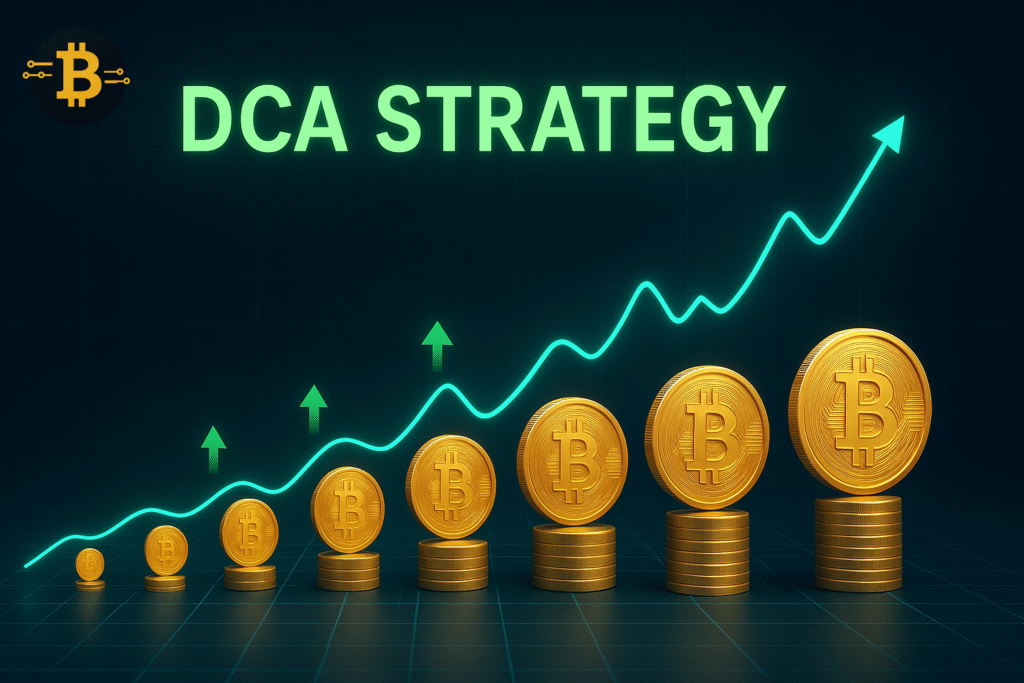
Dollar-cost averaging Bitcoin is the single best low-risk investment strategy for beginners. Here’s how it works and why it’s so effective:
The Strategy Explained:
Instead of investing $1,000 all at once, you invest $100 every month for 10 months. Alternatively, you might invest $50 bi-weekly or $25 weekly – whatever schedule aligns with your income and comfort level. The key is consistency regardless of Bitcoin’s current price.
Why Dollar-Cost Averaging Works:
Removes timing pressure. You don’t need to guess whether “now” is the right time to buy. You buy regardless of price, removing the paralysis that comes from trying to predict market movements.
Averages out volatility. Sometimes you buy when Bitcoin is expensive, sometimes when it’s cheap. Over time, these purchases balance out to a reasonable average price that smooths the volatility curve.
Builds sustainable discipline. Automated, consistent purchases become a habit rather than a stressful decision. You’re not constantly monitoring prices or debating whether to buy – the system handles it.
Reduces emotional decision-making. No panic about price drops or FOMO during surges. Your investment continues steadily while emotions fluctuate wildly around you.
Proven by historical data. Numerous studies show DCA into Bitcoin beats attempting to time the market for the vast majority of investors, especially beginners without sophisticated trading experience.
Real-World Example:
Imagine you started dollar-cost averaging with $100 monthly in January 2020. Some months you bought Bitcoin at $7,000, other months at $11,000, and yes, some purchases happened at $50,000 during the 2021 peak. Your average purchase price would be approximately $25,000. Even after the 2022 bear market and subsequent recovery, you’d be significantly ahead in 2024.
Compare this to someone who invested $1,200 all at once in November 2021 near the $69,000 peak. They’d still be underwater years later, likely having panic-sold at a massive loss during the crash.
How to Implement DCA:
Most major exchanges offer automated recurring purchases. On Coinbase, Kraken, or Gemini, you can set up recurring buys in minutes. Connect your bank account, choose your purchase amount and frequency, and the exchange handles everything automatically. Swan Bitcoin specializes specifically in Bitcoin DCA with particularly low fees for this purpose.
Set it once and genuinely forget about it. Don’t check prices daily. Let the system work for 6-12 months minimum before evaluating results.
2. Start With Small Positions You Can Afford to Lose
The golden rule of Bitcoin investment: only invest money you can genuinely afford to lose completely without impacting your financial stability or peace of mind.
For most beginners, this means:
$10-50 for your absolute first purchase, purely to learn the process without any meaningful financial risk. This is your practice run to understand how exchanges work, how long transactions take, and how to read your Bitcoin balance.
5-10% of your “risk capital” – money beyond your emergency fund, retirement accounts, and necessary savings. This is money earmarked for potentially higher-return, higher-risk investments.
Never money needed for rent, bills, debt payments, or upcoming necessary expenses. The moment you invest money you can’t afford to lose, every Bitcoin price drop becomes a financial emergency rather than a normal market fluctuation.
Never borrowed money, credit card purchases, or loans. Paying interest while Bitcoin potentially decreases is a double loss that has destroyed countless beginner investors financially and emotionally.
The Psychological Benefit:
When your investment is small enough that a 50% drop doesn’t keep you awake at night, you can hold through volatility instead of panic-selling at the worst possible moment. This emotional stability is worth more than aggressive position sizing that creates stress and poor decisions.
Test Transaction Approach:
- Start with $10-20 to test the entire process from purchase to storage
- Learn how your chosen exchange works without meaningful risk
- Practice sending Bitcoin to a wallet (critical skill)
- Once comfortable with the mechanics, gradually increase based on your risk tolerance and financial situation
Remember this perspective: Bitcoin has grown over 10,000% since 2013. Those who succeeded started small, stayed patient through multiple boom-and-bust cycles, and accumulated consistently. They didn’t get rich from one large, perfectly-timed purchase – they built wealth through disciplined, sustained participation.
3. Use Reputable, Regulated Platforms
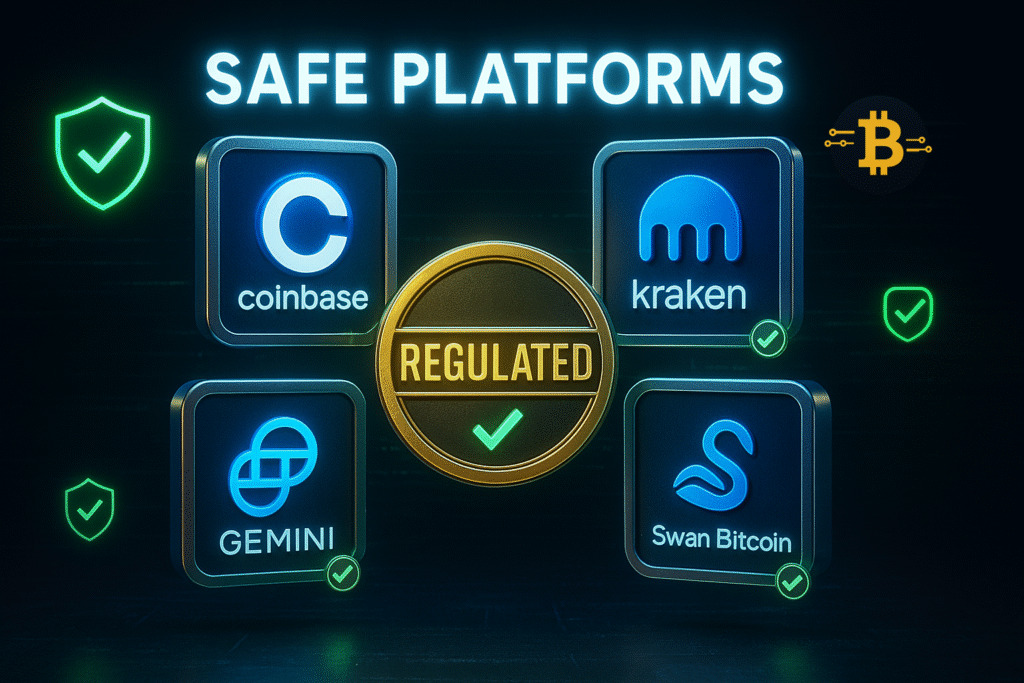
Choosing where to buy Bitcoin safely matters as much as the investment decision itself. Unregulated platforms have collapsed, been hacked, or turned out to be outright scams—taking investors’ money with them. The graveyard of failed exchanges is littered with billions in lost user funds.
What Makes a Platform Safe:
✓ Regulatory licensing. The exchange is registered with financial authorities in major jurisdictions. In the United States, this means FinCEN registration at the federal level plus money transmitter licenses in each state where they operate. International equivalents include FCA registration in the UK, MAS licensing in Singapore, or equivalent oversight.
✓ Long operational history. The platform has operated successfully for at least 3-5 years without major security incidents, user fund losses, or regulatory shutdowns. Time proves stability.
✓ Proof of reserves. The exchange can prove they hold customer funds through third-party audits. After the FTX collapse in 2022, this became a critical trust signal. Legitimate exchanges now regularly publish proof-of-reserves reports.
✓ Insurance coverage. FDIC insurance for USD deposits (up to $250,000) and private insurance policies for cryptocurrency holdings. While not comprehensive protection, insurance demonstrates financial responsibility.
✓ Strong security infrastructure. Mandatory two-factor authentication, cold storage for 95%+ of customer funds, withdrawal whitelist options, and security key support. The exchange takes security seriously at the infrastructure level.
✓ Transparent fee structure. All fees are clearly displayed with no hidden costs. You know exactly what you’re paying for trades, deposits, and withdrawals before committing.
✓ Responsive customer support. Real human support that responds within reasonable timeframes (24-48 hours). Not perfect, but accessible when problems arise.
✓ Identifiable leadership. Known founders and executives with real professional reputations at stake. Anonymous leadership makes accountability impossible and increases exit scam risk.
Recommended Platforms for Beginners:
For United States Investors:
Coinbase: Most beginner-friendly interface, publicly traded company (NASDAQ: COIN), heavily regulated, FDIC insured for USD, strong security. Downside: Higher fees (1.5-2%) compared to alternatives, but the simplicity and security justify the cost for beginners.
Kraken: Lower fees (0.16-0.26%), excellent security reputation, proof-of-reserves pioneer, more complex interface than Coinbase. Better for cost-conscious beginners willing to climb a moderate learning curve.
Gemini: Founded by the Winklevoss twins, regulated, insured, strong security focus, moderate fees (0.5-1%). Good middle ground between Coinbase’s simplicity and Kraken’s cost savings.
Swan Bitcoin: Designed specifically for dollar-cost averaging, Bitcoin-only (no altcoins), educational resources, low fees (0.99-1.49%). Perfect if DCA is your chosen strategy and you’re focused exclusively on Bitcoin.
For International Investors:
Binance: Largest exchange by trading volume, available in 190+ countries, extensive features. However, check whether it’s properly regulated in your specific country, as regulatory status varies significantly by jurisdiction.
Kraken: Available internationally with generally good regulatory standing across multiple countries.
Red Flags to Avoid Completely:
❌ Offshore exchanges with no clear regulatory jurisdiction or oversight.
❌ Platforms promising guaranteed returns, referral bonuses, or interest rates significantly above market.
❌ Exchanges that launched within the last 6-12 months without established track record.
❌ Peer-to-peer platforms without proper escrow if you’re a beginner (too risky without experience).
❌ Anyone asking for your private keys, seed phrase, or direct wallet-to-wallet transactions claiming to be an “exchange.”
| Exchange | Best For | Fees | Security | Ease of Use |
| Coinbase | Complete beginners | High (1.5-2%) | Excellent (insured, regulated) | Very Easy |
| Kraken | Cost-conscious beginners | Low (0.16-0.26%) | Excellent | Moderate |
| Gemini | Security-focused | Moderate (0.5-1%) | Excellent (insured, regulated) | Easy |
| Swan Bitcoin | DCA investors | Low (0.99-1.49%) | Excellent | Very Easy |
| Cash App | Micro investments | Moderate (~2%) | Good | Very Easy |
4. Bitcoin Savings Plans and Auto-Invest Features
Automated Bitcoin buying removes the emotional element entirely from your investment process. Most major exchanges now offer “auto-invest” or “recurring buy” features that implement dollar-cost averaging automatically without requiring any ongoing decisions from you.
How Automated Investing Works:
Connect your bank account or debit card to your chosen exchange one time during initial setup. Set your purchase amount – this could be $10, $25, $50, $100, or any amount that fits your budget and risk tolerance. Choose your purchase frequency: daily, weekly, biweekly, or monthly depending on your income schedule and preferences.
The exchange then automatically purchases Bitcoin on your chosen schedule. You don’t need to log in, make decisions, or think about timing. The investment happens in the background while you focus on your life and career.
Platforms With Excellent Auto-Invest Features:
Swan Bitcoin: Designed specifically for automated Bitcoin dollar-cost averaging. The entire platform is built around this strategy with particularly low fees, educational content focused on long-term holding, and a philosophy aligned with disciplined accumulation rather than trading.
Coinbase: “Recurring buys” feature is very easy to set up through their intuitive interface. Integration with Coinbase’s other services makes this seamless for beginners already familiar with their platform.
Cash App: Offers simple recurring Bitcoin purchases with an incredibly easy mobile-first interface. Perfect for younger investors comfortable with mobile banking who want Bitcoin exposure without complexity.
River Financial: Lower-fee auto-invest option with a focus on education and long-term Bitcoin accumulation. Growing platform with good reputation among Bitcoin-focused investors.
The Psychological Advantage:
You’re not constantly checking prices, which removes the temptation to make emotional decisions. You’re not stressing about whether today is the “right” day to buy. You’re not experiencing FOMO during rallies or fear during crashes. Your investment grows steadily in the background while market noise fluctuates around you.
This autopilot approach has proven more successful for the average investor than any active trading strategy. Set it up properly once, then let compound consistency work its magic over years.
5. Diversify Your Entry Methods
You don’t have to choose just one investment approach. Many successful Bitcoin investors split their strategy across multiple methods to balance consistency with opportunistic flexibility.
Example Allocation Strategy:
60% Dollar-Cost Averaging: Your core strategy. $100 per month in automated purchases regardless of price. This ensures consistent exposure and removes timing pressure completely.
30% Opportunistic Buying: Save $50 per month in a separate account. Only deploy this during significant market corrections of 20% or more from recent highs. This takes advantage of fear-driven crashes when excellent buying opportunities emerge.
10% Lump Sum: When you receive unexpected windfalls like work bonuses, tax refunds, or gifts, consider allocating a portion to Bitcoin. These irregular large purchases complement your regular DCA.
Why This Combined Approach Works:
DCA gives you consistent exposure regardless of price movements, ensuring you’re always participating in Bitcoin’s long-term growth trajectory. Opportunistic buying lets you take advantage of crashes that create excellent value opportunities when fear drives prices below fair value. Lump sum purchases let you deploy larger amounts strategically when your financial situation allows.
Combined, you average good entry points across market cycles while maintaining discipline. The predetermined rules – like “I only buy with saved opportunistic funds during 20%+ drops” – prevent emotional decisions. You’re not randomly buying based on feelings; you’re executing a systematic strategy.
6. Set a Clear Allocation Limit
Before making your first Bitcoin purchase, decide what percentage of your overall investment portfolio or monthly income you’re comfortable allocating to cryptocurrency. This predetermined limit protects you from over-investing during FOMO-driven market peaks.
Conservative Approach: 5-10% of total investment portfolio. Appropriate for risk-averse investors, those near retirement, or beginners still learning about cryptocurrency fundamentals.
Moderate Approach: 10-20% of investment portfolio. Suitable for younger investors with longer time horizons, those comfortable with volatility, or investors who understand Bitcoin’s value proposition deeply.
Aggressive Approach: 20-30% maximum. Only for high-risk tolerance individuals, younger investors with decades until retirement, or those who can genuinely afford significant portfolio losses without lifestyle impact.
Why Allocation Limits Matter:
A predetermined percentage prevents over-investing during FOMO moments. When Bitcoin surges 50% and everyone around you is talking about it, you’ll face intense temptation to dump your entire savings into crypto. Your allocation rule protects you from your own emotional impulses.
This discipline keeps you diversified across asset classes, reducing concentration risk. If Bitcoin crashes 80% (which has happened multiple times historically), you haven’t lost everything because it was only 10-15% of your portfolio.
Example in Practice:
“I will invest no more than 10% of my investment portfolio in Bitcoin, regardless of performance. If Bitcoin appreciates and becomes 15% of my portfolio through price gains, I’ll rebalance by taking profits. If it crashes and becomes 5%, I’ll buy more to return to my 10% target.”
This rebalancing approach forces you to buy low and sell high – the opposite of emotional investing, which typically means buying high and selling low.
7. Focus on Long-Term Holding, Not Trading
Short-term Bitcoin trading is one of the fastest ways for beginners to lose money. The statistics are absolutely brutal: over 90% of day traders lose money, and cryptocurrency’s 24/7 volatility makes it even harder than traditional markets.
The Low-Risk Alternative: Buy and hold for 3-5+ years minimum, called “hodling” in crypto culture (misspelling of “hold” that became community terminology). This long-term approach has historically been the most profitable strategy for average investors.
Why Long-Term Holding Works:
Historical performance is compelling. Bitcoin has never been lower after any 4-year period since its creation in 2009. Every single person who bought Bitcoin and held for four years or longer is in profit, regardless of when they bought.
Removes timing requirement. You don’t need to predict short-term price movements, which is nearly impossible even for professional traders. You just need conviction that Bitcoin will be worth more in 5 years than today.
Avoids trading fees eating returns. Every trade incurs fees. Active traders can easily spend 5-10% annually on trading costs, which dramatically reduces net returns even before considering taxes.
Eliminates daily stress. You’re not obsessively watching price charts, analyzing technical indicators, or losing sleep over market movements. You can focus on your career and life while your Bitcoin investment works in the background.
Tax advantages. In many countries including the United States, holding cryptocurrency for over one year qualifies for long-term capital gains rates, which are significantly lower than short-term rates applied to frequent trading.
The Historical Data:
Anyone who bought Bitcoin at the 2013 peak of $1,100 and held through the 80% crash would have 40x gains by 2024. Anyone who bought at the 2017 peak of $19,000 would have over 200% gains. Even buying at the 2021 peak of $69,000 – the worst possible recent timing – would show profits by late 2024.
Your Job as a Beginner Investor:
Accumulate Bitcoin consistently through DCA or your chosen method. Hold through the inevitable volatility without panic-selling during corrections. Ignore short-term noise from media, social media, and market commentators. Maintain your long-term perspective of 3-5 years minimum. Remember that every successful Bitcoin investor held through multiple 50%+ crashes.
How to Store Bitcoin Safely: Wallets Explained
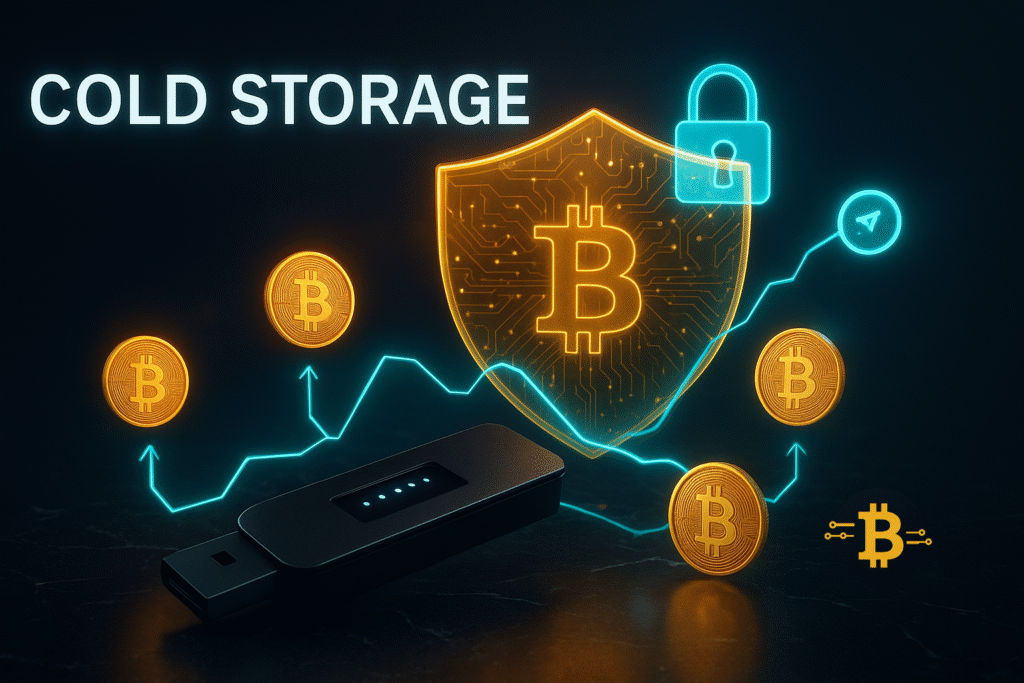
Buying Bitcoin is only half the equation – storing it safely is equally critical for protecting your investment. Poor storage practices have led to billions in losses through exchange hacks, lost passwords, and user errors. Here’s how beginners should approach Bitcoin storage.
Custodial vs Non-Custodial Wallets: The Fundamental Choice
Your first storage decision: who controls your Bitcoin? This choice has profound implications for security, convenience, and responsibility.
Custodial Wallets (Exchange Holds Your Bitcoin):
Examples include keeping your Bitcoin on Coinbase, Kraken, Binance, or any exchange where you bought it. The exchange generates and controls the private keys to your Bitcoin. You access your holdings through username and password like any website.
Advantages: Extremely convenient for beginners. No responsibility for managing complex private keys. Password recovery options if you forget credentials. Easy to trade or sell when desired. Integrated features like automatic purchasing and price alerts.
Disadvantages: You don’t technically own your Bitcoin – the exchange does. Vulnerable to exchange hacks affecting all users. At risk if the exchange goes bankrupt (remember FTX in 2022). Exchange can freeze your account for various reasons. Not aligned with Bitcoin’s core principle of self-sovereignty.
Best for: Complete beginners with small amounts (under $500), active traders who need frequent access, those not comfortable managing private keys independently.
Non-Custodial Wallets (You Control Your Bitcoin):
Examples include hardware wallets like Ledger and Trezor, or software wallets like Blue Wallet and Electrum where you generate and control your own private keys. No company has access to your Bitcoin.
Advantages: You own and control your Bitcoin completely. Not affected by exchange problems, hacks, or bankruptcies. True financial self-sovereignty aligned with Bitcoin’s original vision. Privacy advantages since no company tracks your holdings.
Disadvantages: Full responsibility for security with no customer support. No password recovery if you lose seed phrase – your Bitcoin is gone forever. Steeper learning curve for setup and usage. Must understand concepts like private keys, seed phrases, and transaction signing.
Best for: Long-term holders, amounts over $500, anyone prioritizing security and control over convenience.
My Recommendation for Beginners:
Under $500: Keep on a reputable regulated exchange like Coinbase or Kraken. The convenience outweighs the custodial risk at this amount level.
$500-$5,000: Seriously consider moving to a hardware wallet. The security upgrade justifies the learning effort and device cost.
Over $5,000: Hardware wallet is non-negotiable. The risk of keeping large amounts on exchanges is too high given historical precedent of exchange failures.
Hardware Wallets: The Gold Standard for Secure Storage
Hardware wallets are physical devices specifically designed to store cryptocurrency private keys completely offline. Think of them as ultra-secure USB drives purpose-built for Bitcoin and other cryptocurrencies.
How Hardware Wallets Provide Superior Security:
Your private keys are generated and stored inside the device itself using specialized secure elements – the same chips used in credit cards and passports. These keys never leave the device, even when you connect it to potentially compromised computers.
When you want to make a transaction, you connect the hardware wallet, review transaction details on the device’s screen, and approve by pressing physical buttons. The transaction signing happens internally within the secure element, so your computer never sees your private keys even if infected with malware.
This air-gapped approach protects against keyloggers, clipboard hijackers, phishing websites, and virtually all remote attacks. Someone would need physical possession of your device plus your PIN to access your Bitcoin.
Best Hardware Wallets for Beginners:
Ledger Nano X ($149): Most popular hardware wallet with proven track record since 2014. User-friendly interface with excellent mobile app. Bluetooth connectivity for smartphone use. Supports 5,500+ cryptocurrencies beyond Bitcoin. Comprehensive tutorials and strong customer support. Large community means easy troubleshooting.
Trezor Model T ($219): Open-source firmware allowing security audits by independent researchers. Color touchscreen interface that’s intuitive to navigate. No Bluetooth (some consider this a security advantage). Strong reputation and 10+ year track record. Slightly steeper learning curve but maximum transparency.
Coldcard ($148): Bitcoin-only wallet (simpler, more secure than multi-currency). Air-gapped operation – can generate transactions without ever connecting to a computer. Security-focused features like duress PINs. Best for security purists. Steeper learning curve, recommended for intermediate users.
The Setup Process:
Purchase your hardware wallet directly from the manufacturer’s official website – never from Amazon, eBay, or third-party retailers where devices could be compromised before reaching you. This is critical.
Initialize the device following the manufacturer’s instructions. The device generates a new, completely random seed phrase during this process.
Write down your seed phrase on the provided card using permanent ink. This 12-24 word sequence is your backup that can recreate your wallet if the device is lost or damaged.
Set a strong PIN for the device itself. This protects against theft – someone who steals your device still can’t access it without the PIN.
Transfer a small test amount of Bitcoin from your exchange to your hardware wallet address. Verify it arrives correctly before sending larger amounts.
Store your device in a secure location like a safe. Keep your seed phrase in a separate physical location – never together with the device. Consider fireproof and waterproof storage solutions for the seed phrase.
Cost-Benefit Analysis:
A $150 hardware wallet can protect $50,000+ in Bitcoin indefinitely. It’s insurance that costs far less than the value it protects. Given Bitcoin’s volatility and potential appreciation, spending 0.3% of a $50,000 position on proper security is obviously worthwhile.
| Wallet Type | Security Level | Ease of Use | Cost | Best For |
| Exchange (Custodial) | Medium | Very Easy | Free | Under $500, active traders |
| Mobile Wallet | Medium | Easy | Free | Daily spending, small amounts |
| Hardware Wallet | Very High | Moderate | $50-$220 | $500+, long-term storage |
| Paper Wallet | High (if done correctly) | Very Complex | Free | Advanced users only (not recommended) |
Seed Phrase Security: Your Most Critical Responsibility
Your seed phrase is a 12-24 word sequence that can recreate your entire Bitcoin wallet. Understanding seed phrase security is absolutely critical because this phrase is functionally equivalent to your Bitcoin itself. Whoever controls the seed phrase controls the Bitcoin.
Critical Security Rules:
✓ Write it on paper or metal. Use permanent ink on quality paper, or stamp it into metal plates designed for seed phrase storage that survive fire and water damage.
✓ Store in secure physical location. Fireproof safe, safety deposit box, or similarly secure location. Consider splitting across two locations for redundancy – half the phrase in one place, half in another.
✓ Never photograph or screenshot. Digital copies can be stolen through cloud backups, device hacks, or unauthorized access to your photo library.
✓ Never store digitally. No saving in email, cloud storage (Google Drive, Dropbox, iCloud), digital notes, password managers, or any computer file. Digital storage introduces too many attack vectors.
✓ Never share with anyone. No exceptions. Not customer support, not admins, not “wallet validators,” not family members except in properly planned inheritance scenarios.
The Only Time You’ll Enter Your Seed Phrase:
Setting up a new hardware wallet device for the first time, or recovering your wallet after device loss or damage. That’s it. If anyone asks you to enter your seed phrase on a website, through customer support, or for “verification,” it’s always a scam without exception.
Your seed phrase is more valuable than your Bitcoin because it IS your Bitcoin. Treat it with absolute paranoia and caution. The inconvenience of extreme security measures is nothing compared to the permanent loss of your investment.
Risk Management Principles Every Bitcoin Investor Needs
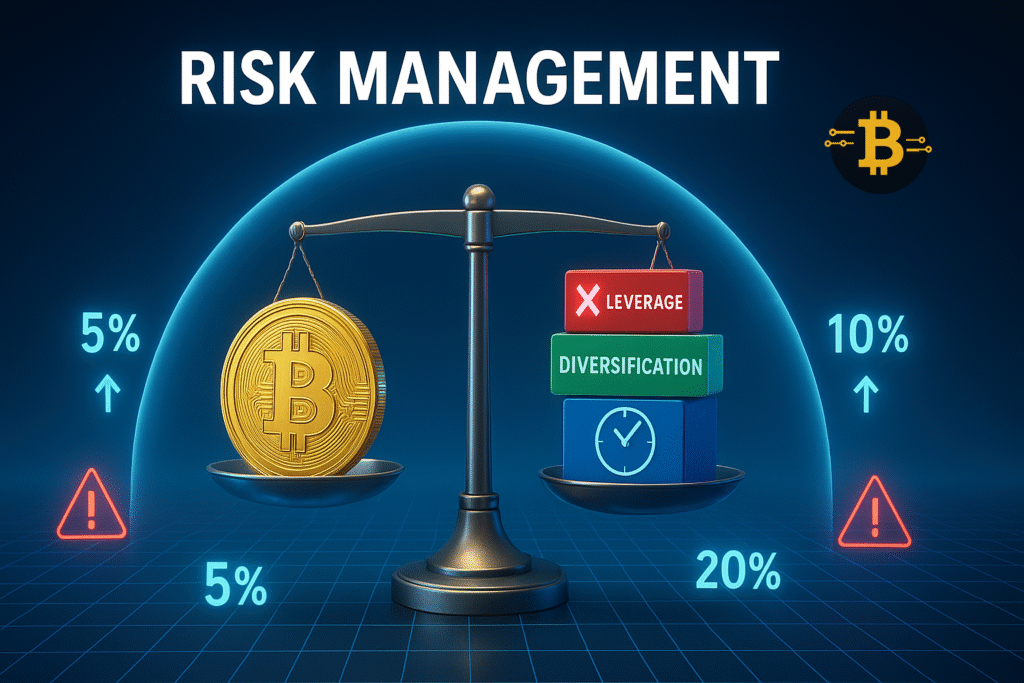
Even with low-risk strategies, Bitcoin remains volatile and requires disciplined risk management. These principles protect you from the biggest mistakes that cause beginners to lose money or miss potential gains.
Rule 1: Never Invest Borrowed Money or Use Leverage
The absolute fastest path to financial disaster: investing borrowed money in Bitcoin or using leverage to amplify positions.
Why This Is Catastrophically Risky:
Bitcoin can drop 30-50% in weeks or even days. Imagine owing money on an asset that just lost half its value – you’re in debt for money that’s gone.
Leverage (borrowing to amplify your position) can liquidate your entire investment in minutes during normal Bitcoin volatility. Exchanges offer 10x, 50x, even 125x leverage, meaning a 2% Bitcoin price drop can wipe out 100% of your investment instantly.
Interest payments on borrowed money compound your losses. You’re paying interest while your collateral depreciates – a double financial blow.
Emotional stress from debt-funded investments clouds judgment completely. You’ll panic-sell at the worst possible moments because you cannot afford to hold through volatility.
The Unbreakable Rule:
Only invest money you already own and can afford to lose completely. No credit cards, no personal loans, no margin trading, no home equity lines, no retirement account withdrawals with penalties. Ever.
If you cannot afford to watch your Bitcoin investment go to zero without major lifestyle impact, you’ve invested too much.
Rule 2: Set Clear Allocation Limits and Stick to Them
Decide before your first purchase: “I will invest no more than X% of my investment portfolio or monthly income in Bitcoin.” Write this down. Review it quarterly but don’t adjust impulsively during emotional market moments.
Why Predetermined Limits Work:
When Bitcoin surges 100% in months, you’ll face intense temptation to go all-in and maximize gains. Your written allocation rule stops this emotionally-driven mistake before it happens.
When Bitcoin crashes 50%, you’ll want to abandon ship entirely. Your allocation rule reminds you this was expected and planned for.
Suggested Allocations by Risk Tolerance:
Conservative: 5% of investment portfolio. Appropriate for risk-averse investors, those approaching or in retirement, or beginners still learning.
Moderate: 10-15% of portfolio. Suitable for younger investors with decades until retirement, those who understand Bitcoin deeply, or comfortable with volatility.
Aggressive: 20-25% maximum. Only for high-risk tolerance, younger investors who can rebuild if needed, or those with substantial other assets providing security.
Never exceed 30% in any single volatile asset. This concentration risk has destroyed portfolios when that asset enters bear markets lasting years.
Rule 3: Ignore Short-Term Price Movements
Checking Bitcoin’s price hourly creates unnecessary stress and leads to bad decisions. The reality: Bitcoin is volatile daily but has trended upward over multi-year periods throughout its history.
The Discipline to Develop:
Check prices weekly or monthly, not daily. Remove price tracking apps from your phone if you find yourself obsessively checking. Focus on consistent accumulation rather than current paper value. Remember you’re investing for 3-5+ years minimum, not 3-5 days or weeks.
Historical Perspective to Maintain:
Bitcoin has experienced six separate drawdowns of 80% or more since creation. Each time, it recovered to new all-time highs within 2-4 years. The investors who succeeded were those who ignored the crashes and continued accumulating.
Everyone who bought Bitcoin at any point in history and held for 4+ years is in profit. This includes people who bought at the worst possible times—market peaks right before crashes. Time heals volatility in this asset.
Mental Framework:
Think of your Bitcoin investment as locked for 4 years minimum. Imagine you cannot access it during this time. This mindset prevents panic during inevitable corrections and maintains focus on the long-term thesis rather than short-term noise.
Rule 4: Don’t Try to Time the Market
“I’ll wait for Bitcoin to drop to $20,000, then I’ll buy!” This thinking causes beginners to miss years of gains while waiting for a price that never materializes, or watching from the sidelines as Bitcoin appreciates well beyond their target entry.
Why Market Timing Fails for Beginners:
By the time you’re confident Bitcoin has hit bottom, the price has usually already recovered significantly. The true bottom is only obvious in retrospect.
You miss entire rallies waiting for crashes that don’t happen as expected. Bitcoin could go from $40,000 to $80,000 while you’re waiting for it to hit $30,000.
Emotional paralysis when prices do drop: “It might go lower, I’ll wait a bit more…” Then it bounces and you’ve missed the opportunity you were waiting for.
What Research Shows:
Studies across all asset classes demonstrate that “time in the market beats timing the market” for average investors. Dollar-cost averaging consistently outperforms attempts to buy at perfect bottoms for those without sophisticated trading experience and analytical tools.
The Solution:
DCA removes timing pressure entirely. You automatically buy more Bitcoin when it’s cheap and less when it’s expensive, without needing to predict price movements. The math works in your favor over time.
Red Flags to Avoid When Investing in Bitcoin
The Bitcoin space contains legitimate opportunities and outright scams. These red flags help you identify what to avoid as a beginner investor navigating this environment.
Warning Signs That Scream “Scam” or “Bad Idea”:
1. Guaranteed returns or profits. No legitimate investment can guarantee returns in Bitcoin’s volatile market. Anyone promising specific returns – specially high ones – is running a Ponzi scheme.
2. “Join my signal group for insider tips.” Trading signal groups profit from you, not for you. They often operate pump-and-dump schemes where you’re the exit liquidity.
3. Anyone asking for seed phrase or private keys. This is instant scam territory with zero exceptions. Legitimate services never need this information.
4. Unknown “Bitcoin investment funds” promising 10%+ monthly returns. Classic Ponzi scheme pattern. Unsustainable returns funded by new investor money until collapse.
5. Fake celebrity giveaways. The “Send 1 BTC, receive 2 BTC back” scams impersonating Elon Musk or other celebrities are always fraud. Real giveaways never require you to send crypto first.
6. Unregulated exchanges offering large bonuses to deposit. Often these platforms make it impossible to withdraw later, effectively trapping your funds.
7. Peer-to-peer trades without escrow services. High scam risk for beginners who don’t understand how to structure safe P2P transactions.
8. “Bitcoin mining apps” on smartphones. You cannot mine Bitcoin on a phone—it’s technically impossible. These are malware or data collection schemes.
9. Pressure to “act now or miss out.” Legitimate investment opportunities don’t require rushed decisions. Urgency is a manipulation tactic.
10. Platforms that won’t let you withdraw. If you cannot withdraw your Bitcoin to an address you control, you never actually owned it. Many scams operate like this.
Additional Mistakes Beginners Must Avoid:
Cloud mining contracts. Almost always scams or unprofitable. Real Bitcoin mining requires industrial-scale operations with specialized hardware and cheap electricity access.
Altcoin distractions. Scammers create thousands of fake “next Bitcoin” coins with zero real utility. As a beginner, focus on Bitcoin from regulated exchanges.
“Pump and dump” groups. Telegram or Discord groups coordinating buying of obscure coins to inflate price, then dumping on newcomers who buy high.
Leverage trading as a beginner. Even on legitimate platforms, over 90% of leverage traders lose money. The odds are mathematically against you without professional experience.
General Principle:
If something sounds too good to be true or you don’t fully understand it, don’t invest. Bitcoin’s value proposition comes from long-term adoption as sound money and store of value, not get-rich-quick schemes. Real wealth building in Bitcoin happens slowly through consistent accumulation and patience.
Your Step-by-Step Bitcoin Investment Roadmap
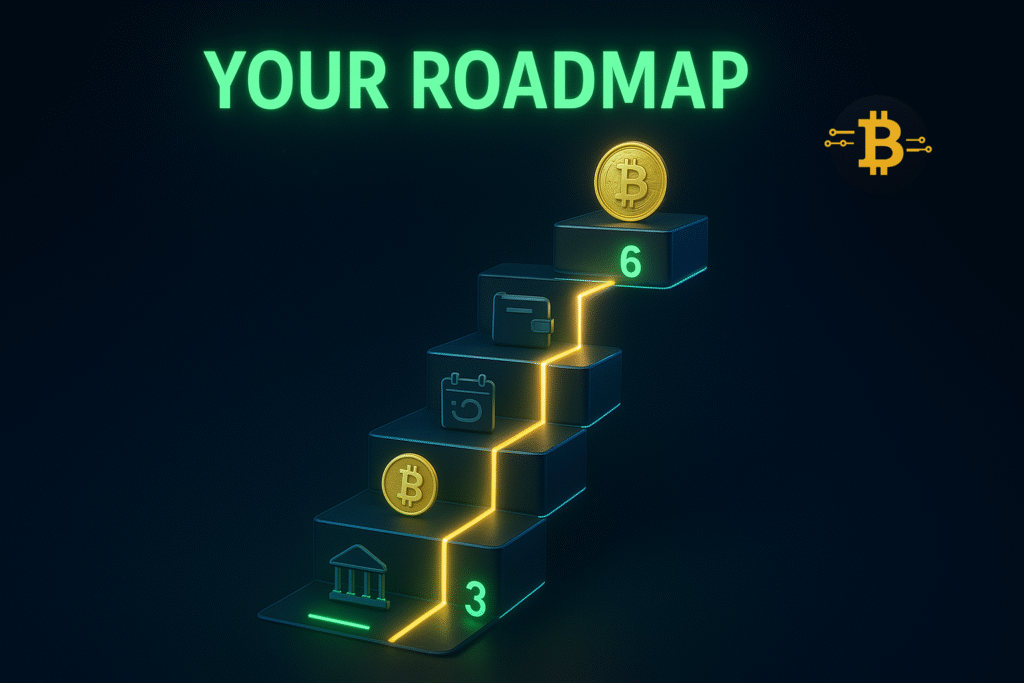
Ready to start? Here’s your exact action plan for how to start investing in Bitcoin safely, from complete beginner to confident long-term holder.
Step 1: Choose a Trusted Exchange (Week 1)
Research exchanges available in your country. For US investors, consider Coinbase (easiest), Kraken (lower fees), or Gemini (security-focused). Verify the exchange is properly regulated in your jurisdiction.
Create your account and complete the KYC (Know Your Customer) verification process. This typically requires uploading government-issued ID and sometimes proof of address. While annoying, proper KYC is actually a sign of regulatory compliance.
Link your bank account or debit card. Use direct bank linking rather than wire transfers when possible – it’s typically cheaper and more convenient.
Enable two-factor authentication immediately. Use an authenticator app like Google Authenticator or Authy, not SMS which is vulnerable to SIM-swapping attacks.
Step 2: Make a Tiny Test Purchase (Week 1)
Buy $10-25 worth of Bitcoin for your very first purchase. This small amount lets you learn the entire process without meaningful financial risk.
Confirm the Bitcoin appears in your exchange wallet. Understand that it may take minutes to hours depending on network congestion.
Celebrate – you now own Bitcoin! You’ve crossed the psychological barrier that stops most people from ever starting.
Step 3: Set Up Dollar-Cost Averaging (Week 2)
Decide your investment amount based on your budget and risk tolerance. This could be $25, $50, $100, or $200 monthly – whatever fits your financial situation comfortably.
Enable automatic recurring purchases on your exchange. Most platforms make this easy through their settings or automatic investment sections.
Set it and forget it for at least 6 months. Don’t constantly adjust based on price movements. Let the strategy work as designed.
Step 4: Learn Basic Wallet Security (Weeks 2-3)
Practice sending a tiny amount ($5-10) between your exchange and a mobile wallet like Blue Wallet. This teaches you how Bitcoin transactions actually work.
Understand the difference between custodial and non-custodial storage. Read about private keys and seed phrases until the concepts click.
Research hardware wallets even if you’re not ready to buy one yet. Understand why they’re recommended for amounts over $500.
Step 5: Move to Hardware Wallet (When You Reach $500+)
Purchase a Ledger or Trezor hardware wallet from the manufacturer’s official website only. Never buy from third-party sellers.
Set up the device following all security instructions carefully. Generate and securely store your seed phrase using the methods described earlier.
Transfer your Bitcoin from the exchange to your hardware wallet address. Start with a small test transaction, then move the rest once confirmed.
Verify everything arrived correctly, then store your hardware wallet securely. Keep the device and seed phrase in separate locations.
Step 6: Stick to Your Plan Long-Term
Resist checking prices daily. Focus on your life, career, and other goals while your Bitcoin investment grows in the background.
Continue your dollar-cost averaging regardless of price movements. Don’t stop during crashes (that’s when you’re getting the best deals) or during rallies (you still want consistent exposure).
Review your investment quarterly, not daily or weekly. Check whether your allocation percentage is still appropriate and whether any rebalancing is needed.
Don’t panic during corrections – they’re completely normal in Bitcoin’s history. Every significant holder has experienced multiple 50%+ drawdowns.
Hold for at least 3-5 years minimum for best results. Bitcoin’s real returns manifest over market cycles, not weeks or months.
This roadmap has worked for thousands of beginners I’ve taught over the past decade. The key principles: start small to build confidence, stay consistent through all market conditions, prioritize security as your holdings grow, and ignore the constant noise from media and social media. Your future self will thank you for starting today rather than waiting for the mythical “perfect” time that never actually arrives.
Frequently Asked Questions About Investing in Bitcoin
Is Bitcoin a good investment for beginners?
Yes, Bitcoin can be an excellent investment for beginners if approached with the right strategy and mindset. Dollar-cost averaging eliminates timing pressure, starting with small amounts reduces financial risk, and using regulated platforms provides security during the learning phase.
However, you must be genuinely comfortable with significant volatility – 50% drawdowns are normal in Bitcoin’s history. Only invest money you can afford to lose completely without impacting your financial stability or causing stress that affects your life quality.
Bitcoin has a 15-year track record showing consistent long-term growth despite short-term volatility. Beginners who stay disciplined, avoid emotional decisions, and maintain multi-year time horizons have historically been well-rewarded. The key is realistic expectations and proper strategy execution.
How much money do I need to start investing in Bitcoin?
You can start investing in Bitcoin with as little as $1 on most major exchanges. The fractional nature of Bitcoin (divisible to 8 decimal places) means you don’t need thousands of dollars to begin.
However, I recommend starting with $10-50 for your first purchase to make it meaningful enough to care about while still being a trivial amount if something goes wrong during the learning process. For ongoing dollar-cost averaging, $25-100 monthly is realistic for most beginners and builds substantial positions over time.
The key insight: someone consistently investing $50 monthly will likely outperform someone who invests $5,000 once and then panic-sells during the first major correction. Consistency matters more than the size of individual purchases.
What is the safest way to buy Bitcoin?
The safest way to buy Bitcoin is through regulated, established exchanges like Coinbase, Kraken, or Gemini that have proper licensing, insurance coverage, and strong security measures. These platforms have operated for years without catastrophic failures affecting users.
Enable two-factor authentication immediately after creating your account. Use strong, unique passwords that you’ve never used elsewhere. Start with a small test purchase to learn the interface before committing larger amounts.
For storing Bitcoin, keep amounts under $500 on the exchange for convenience. Move larger amounts to a hardware wallet like Ledger or Trezor purchased directly from the manufacturer. Never use peer-to-peer trades, unregulated platforms, or anyone asking for your private keys or seed phrases.
Can you lose money investing in Bitcoin?
Yes, you can absolutely lose money investing in Bitcoin, and many beginners do through predictable mistakes. Bitcoin’s price is volatile and can drop 20-50% in short periods. You lose money if you panic-sell during these drops, locking in losses at the worst possible moment.
You also lose through using leverage that liquidates your position, falling for scams and sending Bitcoin to fraudsters, losing access to your wallet by mishandling seed phrases, or investing borrowed money and paying interest while your investment decreases.
However, historical data shows encouraging patterns: anyone who used dollar-cost averaging and held for 4+ years has made substantial gains, regardless of when they started. The distinction between those who lose money and those who profit typically comes down to strategy, discipline, and time horizon rather than luck.
Should I use Coinbase or Binance for Bitcoin?
For beginners, especially those in the United States, Coinbase is generally the better choice. It offers a user-friendly interface designed specifically for beginners, full US regulation and compliance, insurance coverage through both FDIC and private policies, and strong customer support. The tradeoff is higher fees – typically 1.5-2% per transaction.
Binance has significantly lower fees (around 0.1%) and more advanced features, but the interface is more complex and intimidating for beginners. Additionally, Binance faces ongoing regulatory challenges in multiple countries including the United States, creating uncertainty about long-term availability.
My recommendation: Start with Coinbase or Kraken (which splits the difference with moderate fees and moderate complexity). Once you’re comfortable and understand the processes, you can evaluate whether switching to lower-fee platforms justifies the additional complexity. For Bitcoin-only investors focused on dollar-cost averaging, Swan Bitcoin is also excellent with low fees and beginner-friendly education.
Is it too late to invest in Bitcoin in 2025?
No, it’s not too late – Bitcoin remains in relatively early adoption phases despite significant growth. Current estimates suggest only 4-5% of the global population owns any Bitcoin. Major financial institutions like BlackRock, Fidelity, and others have launched Bitcoin ETFs in 2024, bringing institutional capital and legitimacy.
Countries are beginning to adopt Bitcoin as legal tender or strategic reserves. The underlying technology and network continue improving through protocol upgrades. Many analysts believe Bitcoin is still early in its adoption curve compared to previous transformational technologies like the internet or smartphones.
What matters more than timing perfection is your investment approach: dollar-cost averaging over years reduces timing risk to nearly zero. That said, only invest what you can afford to lose, understand the volatility you’re accepting, and maintain a long-term holding perspective of 3-5+ years minimum.
The often-repeated wisdom holds true: the best time to invest in Bitcoin was yesterday; the second-best time is today. Waiting for perfect conditions means missing ongoing appreciation while you deliberate.
What is dollar-cost averaging and why does it work for Bitcoin?
Dollar-cost averaging (DCA) means investing a fixed amount at regular intervals – like $100 every month – regardless of Bitcoin’s current price. Some months you buy when Bitcoin is expensive, other months when it’s cheap. Over time, these purchases average out to a reasonable entry price.
DCA works because it removes the impossible task of predicting short-term price movements. You automatically buy more Bitcoin when prices are low (your fixed dollar amount buys more BTC) and less when prices are high (same dollars buy less BTC). This creates natural buying discipline.
Studies across all asset classes show DCA consistently outperforms trying to time market bottoms for average investors. In Bitcoin specifically, which experiences extreme volatility, DCA smooths your entry across bull and bear markets, removing the emotional stress of trying to “buy the dip” perfectly. Most major exchanges offer automated recurring purchases that implement DCA effortlessly.
Do I need a hardware wallet immediately?
No, you don’t need a hardware wallet for your first Bitcoin purchase. While you’re learning with small amounts under $500, keeping Bitcoin on a reputable regulated exchange like Coinbase or Kraken is acceptable and practical.
Hardware wallets cost $50-220, so buying one before you own significant Bitcoin doesn’t make financial sense. Use your early investment period to learn exchange interfaces, understand how Bitcoin transactions work, and build confidence.
Once your holdings reach $500-1,000 or more, moving to a hardware wallet becomes important. At that point, the security upgrade from hardware wallet storage justifies the cost and learning effort. Think of it as graduating to more advanced security as your investment grows.
Start learning exchange custody, then graduate to self-custody through hardware wallets as your holdings justify the upgrade.
How volatile is Bitcoin really?
Bitcoin is extremely volatile compared to traditional investments like stocks or bonds. Daily price swings of 5-15% are completely normal. Bitcoin has crashed 80% or more from peak prices six different times in its history. A 30% drop within a month is considered a routine correction, not a crisis.
However, examining longer timeframes reveals important patterns: over every 4-year period since creation, Bitcoin has recovered from crashes and reached new all-time highs. The volatility decreases with longer holding periods.
This volatility is why dollar-cost averaging and long-term holding (3-5+ years minimum) are essential strategies. If you need your invested money within 2 years, Bitcoin is probably inappropriate given the realistic possibility of 50% drawdowns during that timeframe. If you cannot psychologically handle watching your investment drop 50% without panic-selling, Bitcoin may not match your risk tolerance regardless of potential returns.
What percentage of my portfolio should be Bitcoin?
Financial advisors typically recommend 5-10% of your investment portfolio for Bitcoin if you’re risk-averse or closer to retirement. This allocation provides meaningful exposure to Bitcoin’s potential upside while limiting damage if it crashes.
Moderate risk tolerance suggests 10-20% allocation, appropriate for younger investors with decades until retirement or those who deeply understand Bitcoin’s value proposition and can weather significant volatility.
Aggressive allocation would be 20-30% maximum – only suitable for high-risk tolerance individuals, younger investors who can rebuild portfolios if needed, or those with substantial other assets providing financial security regardless of Bitcoin’s performance.
Never allocate more than 30% of your investment portfolio to any single volatile asset. This concentration risk has destroyed countless portfolios when that asset enters extended bear markets. Your allocation should align with your age, financial situation, risk tolerance, and investment timeline – not with FOMO or hype cycles.
Can I buy fractional Bitcoin?
Yes, absolutely – you can buy tiny fractions of Bitcoin down to 8 decimal places. The smallest unit is called a “satoshi” (0.00000001 BTC), named after Bitcoin’s creator. This divisibility means you can invest $1, $5, $10, or any amount rather than needing to purchase a whole Bitcoin.
Most exchanges let you specify a dollar amount rather than a Bitcoin amount, making this even simpler. You might buy “$50 of Bitcoin” and the exchange automatically calculates how many sats (satoshis) or fractional BTC that purchases at current prices.
This accessibility is crucial for beginners – you don’t need thousands or tens of thousands of dollars to participate in Bitcoin. Start with whatever amount fits your budget and risk tolerance.
Start Your Bitcoin Investment Journey Today
You now have a complete guide on how to invest in Bitcoin for beginners using low-risk strategies that actually work. You understand why Bitcoin is volatile and how that volatility creates both risk and opportunity. You know seven specific ways to reduce risk, with dollar-cost averaging standing out as the safest and most effective approach for most beginners.
You’ve learned how to choose platforms that won’t disappear with your money, how to store Bitcoin securely as your holdings grow, and the risk management principles that separate successful long-term investors from those who lose money through preventable mistakes.
The difference between those who succeed with Bitcoin and those who get hurt isn’t luck, intelligence, or perfect timing – it’s discipline, strategy, and security practices applied consistently over years.
Don’t wait for the mythical “perfect” time to start. That perfect moment doesn’t exist and never will. Begin with a small amount today, set up automated purchases if DCA fits your approach, and give yourself permission to learn as you go. Your first $10-50 purchase is tuition for understanding Bitcoin firsthand rather than theoretically.
Remember this crucial perspective: Every Bitcoin millionaire and billionaire started with their first small purchase. They weren’t geniuses who perfectly timed the market – they were ordinary people who started early, stayed consistent through volatile cycles, and held through doubt. The best investment strategy is the one you actually execute rather than endlessly researching but never beginning.
Start small. Start today. Your future self will thank you in 5 years.
About This Guide
This guide was researched using data from reputable financial institutions, cryptocurrency exchanges, investment analysis platforms, and blockchain security organizations. Investment strategies and risk management principles are based on historical Bitcoin performance data, academic studies on dollar-cost averaging effectiveness, and a decade of practical experience teaching beginners safe cryptocurrency investment approaches.
Last Updated: December 2025
Sources: Bitcoin price data, exchange comparisons, and investment statistics are from publicly available market data and verified through multiple credible sources including major exchanges, financial research platforms, and blockchain analytics firms.
This content is educational only and does not constitute financial or investment advice. Cryptocurrency carries significant risk including potential complete loss of investment. Always do your own research, understand what you’re investing in, and never invest more than you can afford to lose. Past performance does not guarantee future results.
References
Odu, S. (2025a, November 30). What is a crypto wallet? Complete guide to types, security & the right one. Cryptogiant –. https://cryptogiant.io/what-is-a-crypto-wallet/
Odu, S. (2025b, December 3). How to avoid crypto scams: 15 red flags & protection tips. Cryptogiant –. https://cryptogiant.io/how-to-avoid-crypto-scams/
Bitcoin price today, BTC to USD live price, marketcap and chart. (n.d.). CoinMarketCap. Retrieved December 6, 2025, from https://coinmarketcap.com/currencies/bitcoin/
Buy, sell & Trade bitcoin, Solana, & other cryptos with Gemini’s best-in-class platform. (n.d.). Gemini.com. Retrieved December 6, 2025, from https://www.gemini.com
Getting started – bitcoin. (n.d.). Bitcoin.org. Retrieved December 6, 2025, from https://bitcoin.org/en/getting-started
Hayes, A. (2003, November 26). Dollar-cost averaging (DCA): What it is, how it works, and example. Investopedia. https://www.investopedia.com/terms/d/dollarcostaveraging.asp
Invest in bitcoin. (n.d.). Swan Bitcoin. Retrieved December 6, 2025, from https://www.swanbitcoin.com
Latest crypto news. (n.d.). Coindesk.com. Retrieved December 6, 2025, from https://www.coindesk.com/learn/what-is-bitcoin/
Ledger crypto wallet – security for DeFi & Web3. (2019, April 16). Ledger. https://www.ledger.com
MIT digital currency initiative. (n.d.). MIT Digital Currency Initiative. Retrieved December 6, 2025, from https://dci.mit.edu/
Trezor hardware wallet (official). (n.d.). Trezor.Io. Retrieved December 6, 2025, from https://trezor.io
What is cryptocurrency? Beginner’s guide 2025. (2025, October 7). Cryptogiant –. https://cryptogiant.io/what-is-cryptocurrency/
(N.d.-a). Federalreserve.gov. Retrieved December 6, 2025, from https://www.federalreserve.gov/econres/notes/feds-notes/how-does-bitcoin-fit-into-the-monetary-system-20211022.htm
(N.d.-b). Coinbase.com. Retrieved December 6, 2025, from https://www.coinbase.com
(N.d.-c). Kraken.com. Retrieved December 6, 2025, from https://www.kraken.com
(N.d.-d). Binance.com. Retrieved December 6, 2025, from https://www.binance.com
(N.d.-e). Blockchain.com. Retrieved December 6, 2025, from https://www.blockchain.com/explorer

4 Comments
Pingback: Bitcoin Cash Becomes 2025’s Top L1 Performer—Outpacing Every Major Blockchain - cryptogiant
Pingback: How to Read Crypto Charts: The Complete Beginner’s Guide - cryptogiant
Pingback: Top 10 Crypto Trading Tools Every Trader Should Know
Pingback: Crypto Derivatives Surge to $86T as Institutions Take Over - cryptogiant