

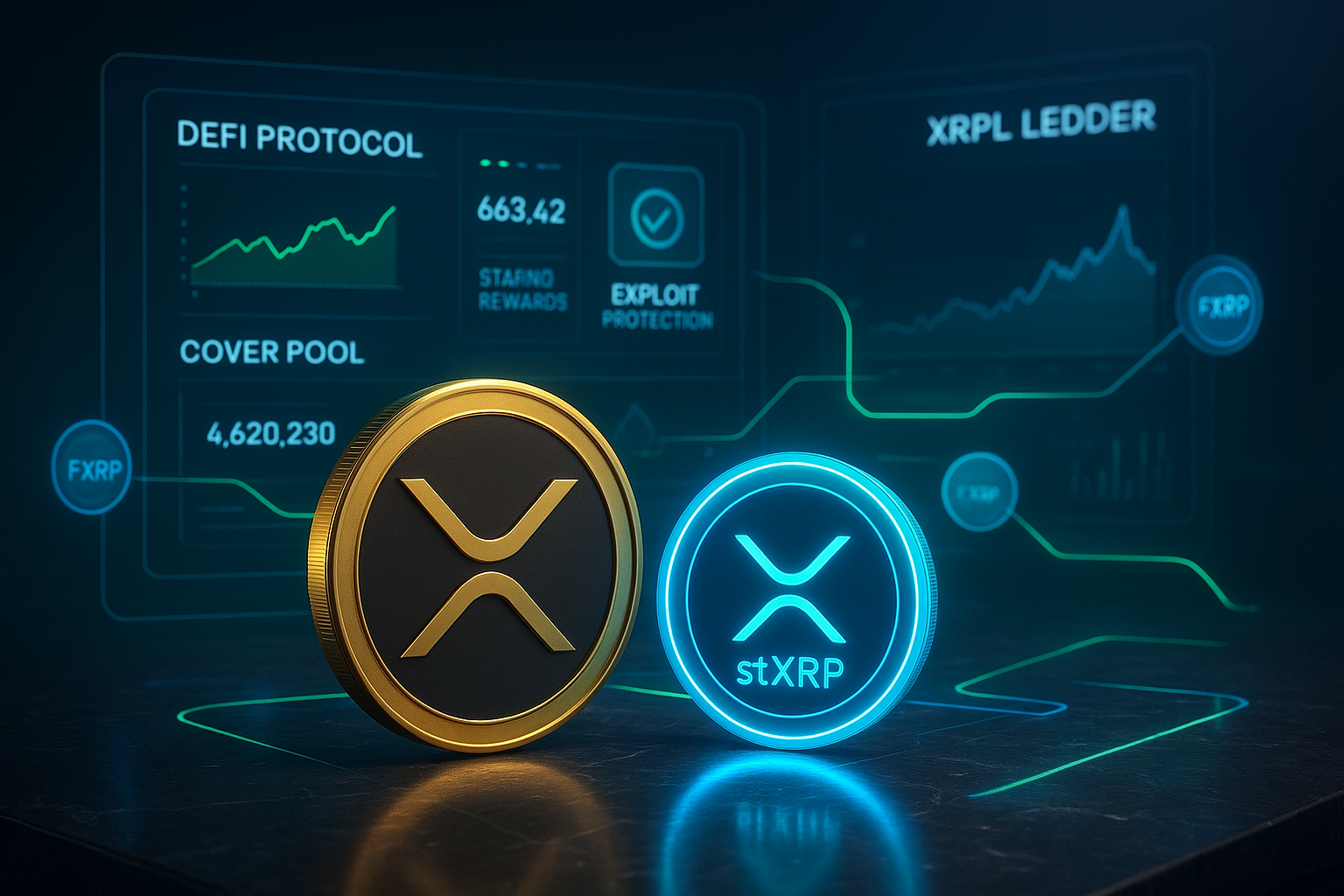
- XRP Staking has gained new utility as Firelight goes live on Flare network
- XRPL documents the second-largest spike of payments, which is an indicator of increased network activity.
- According to analysts, XRP remains bearish unless it regains the $2.30-$2.50 zone as a key reversal point.
Firelight Brings DeFi Insurance and New Yield Path for XRP Holders
Firelight is a new DeFi protocol, developed by Sentora with core backing from the Flare Network, has just opened the door for XRP DeFi staking. The protocol permits holders to earn yield while reinforcing a protective layer against on-chain exploits.
According to Firelight, users can now stake XRP and earn rewards that scale with demand for DeFi “cover” – a structured form of capital designed to help protocols recover from losses. The model mirrors traditional insurance markets, where shared protection is created by risk pools and premiums.
In a Wednesday press release, the team described Firelight as a “capital-efficient protection layer” built to improve resilience across the fast-growing DeFi ecosystem.
According to Connor Sullivan, Firelight’s chief strategy officer, the industry has reached a point when strong risk infrastructure is required. “At this stage in DeFi’s maturity, it needs the same risk infrastructure that supports every other financial market,” he said.
How Firelight’s XRP Staking and Protection Model Works
Firelight’s system works in two phases. First, users deposit XRP and receive stXRP, a liquid ERC-20 token representing their staked position. This new token, stXRP, can then be traded, used as collateral, or placed into liquidity pools within the expanding Flare ecosystem. This gives XRP holders new utility without losing access to their underlying assets.
The second phase is when Firelight’s insurance-like mechanism kicks in. The staked XRP flows into a cover pool, which then becomes a source of underwriting risk for participating DeFi protocols. If a protocol suffers an exploit that meets the payout criteria set by Firelight, compensation can be issued directly from the pool. The premiums to be paid by the covered protocols will fund staking rewards for users, creating a self-sustaining risk market.
Firelight depends on the FAssets system by Flare to allow frictionless interaction between blockchains. It allows users to mint a decentralized synthetic representation of XRP, known as FXRP, without depending on centralized bridges. It is through FXRP that StXRP is minted, therefore it is a clean path for XRP DeFi staking and further integration into the wider Firelight economy.
The security framework of the project has been audited by OpenZeppelin and Coinspect, while an ongoing bug bounty programme is supported by Immunefi.
According to DefiLlama, XRPL’s total value sits at $73 million, meaning there is great potential for further development in DeFi.
XRPL Payment Volume Spike Raises Market Questions
The XRP Ledger, together with Firelight development, documented the second-largest spike of payments in the history of the year, recording approximately 2.23 billion XRP worth of transactions on December 2.
Nevertheless, there is subdued price action. XRP continues to trade in an apparent, downward trending channel, with the 50, 100 and 200 EMAs positioned in a bearish position over the present price. The market did not recover the channel mid-line despite the efforts to bounce. This is a strong indication of constant weakness.
Historically, significant increases in payment volume on XRPL have been followed by either a sudden drop or a decline in trend. However, analysts warn that unless the market breaks out or recovers above the $2.30-$2.50 area, the overall trend will be down.
